How to Study Art With 10 Essential Tips
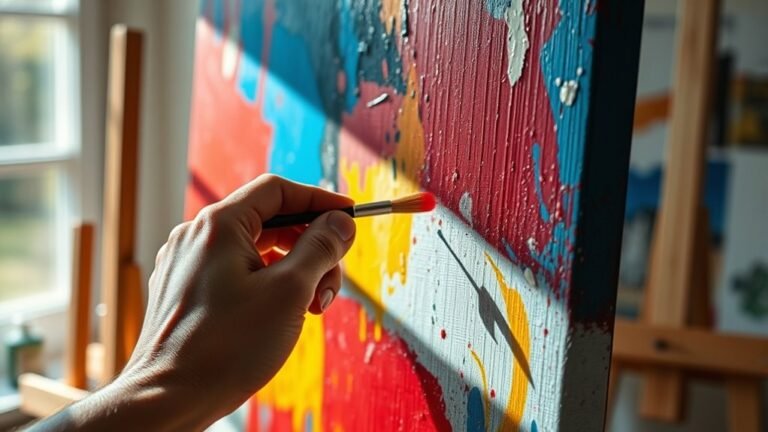
To effectively study art, start by setting small, achievable goals to keep yourself motivated. Creating a consistent daily or weekly routine with focused, manageable sessions really helps build momentum. Studying art isn’t just about talent—it’s about practice, dedication, and having the right approach.
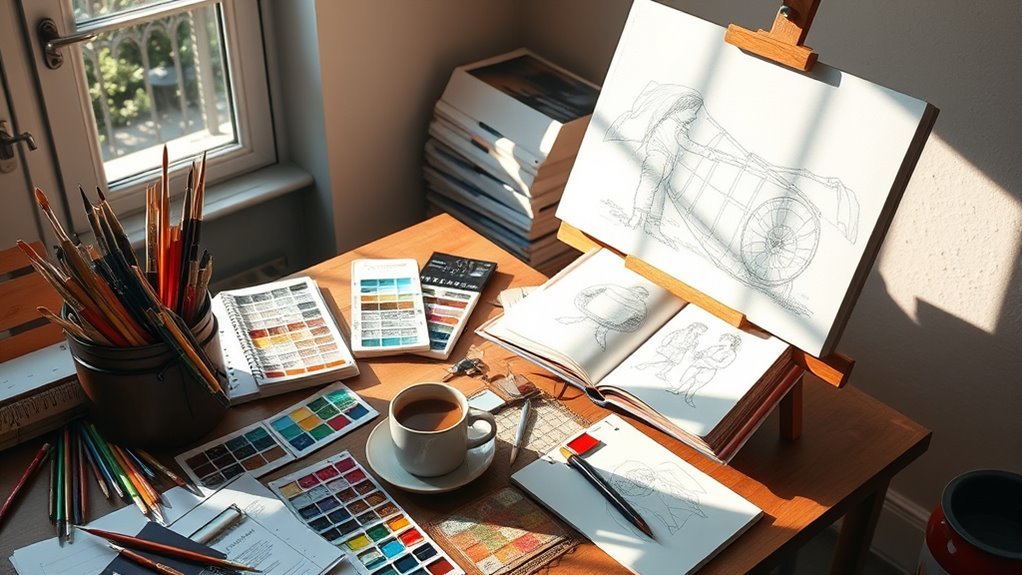
Mastering the fundamentals like anatomy and perspective is key. Use references and real-life observation to understand these basics better. It’s all about seeing and practicing what you see.
Tracking your progress and learning from mistakes can make a huge difference, too.
Don’t be afraid to experiment with different media. Trying new tools and techniques keeps things fresh and exciting.
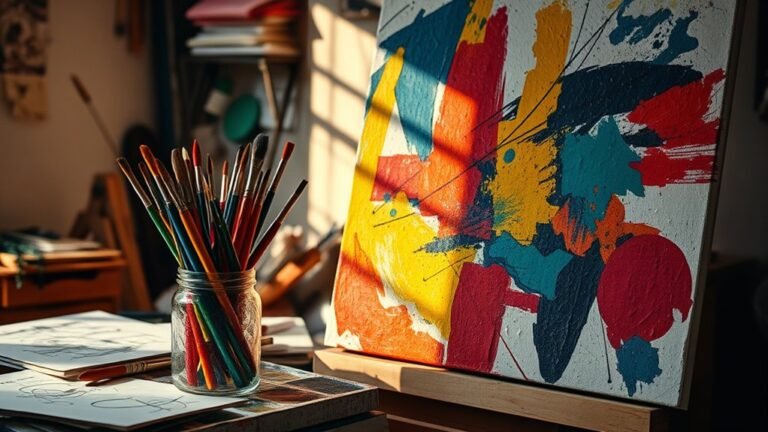
Practice lighting and shading regularly to add depth and realism to your work.
Lastly, avoid burnout by balancing your goals with breaks. Enjoying the process is just as important as the results. Keep going, and you’ll discover even more ways to refine your skills and stay inspired along the way.
Key Takeaways
- Set small, achievable art goals and keep a consistent, manageable routine. This way, you can build steady progress without feeling overwhelmed or burned out.
- Master core fundamentals like anatomy, perspective, and observation. These basics really strengthen your artistic foundation and make everything else easier to learn.
- Practice lighting, shading, and form regularly using references. Doing this helps you add depth, mood, and realism to your work.
- Keep track of your progress by documenting your work and reflecting on mistakes. It’s a great way to see how far you’ve come and spot areas to improve.
- Prioritize consistency, but don’t forget to schedule breaks. Taking time off helps you stay motivated, avoid burnout, and actually enjoy the creative process.
Set Small, Achievable Art Goals to Build Momentum

Although setting ambitious art goals can be exciting, breaking them into small, manageable tasks will help you stay consistent and avoid frustration. By focusing on small goals like daily sketches or weekly exercises, you create a clear path for steady progress in your art practice.
Instead of overwhelming yourself, try dividing your big goals in half to keep targets achievable and realistic. This approach boosts your motivation because each small win feels rewarding and reinforces your momentum.
Break big goals in half to stay motivated with small, rewarding wins that build momentum.
Commit to short, focused sessions of 10 to 30 minutes to maintain your energy and avoid burnout. These incremental improvements build your confidence day by day, turning art practice into a habit.
When you stay consistent with manageable tasks, you’ll notice steady growth in your skills without feeling overwhelmed. Celebrating small achievements keeps your motivation high and ensures you stay on track toward long-term success in your artistic journey.
Create a Sustainable Daily or Weekly Art Routine
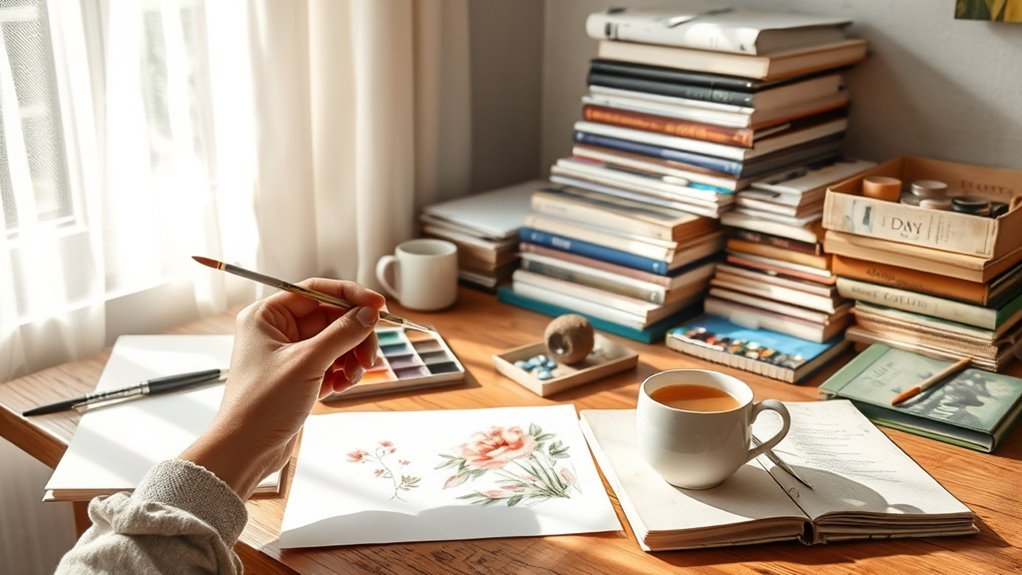
Breaking down your art goals into small tasks sets a strong foundation, but the next step is to build a routine that supports consistent practice. Set aside a specific time each day or week dedicated solely to your art.
Keeping sessions short—between 10 to 30 minutes— helps you stay focused and prevents burnout. Mix up your routine with quick sketches, detailed studies, and moments of reflection to keep things engaging.
Track your progress by saving your work and noting improvements; this will keep you motivated and highlight areas needing attention. Remember, consistency beats intensity—regular, small efforts add up to steady growth over time.
Master Core Fundamentals: Anatomy and Perspective
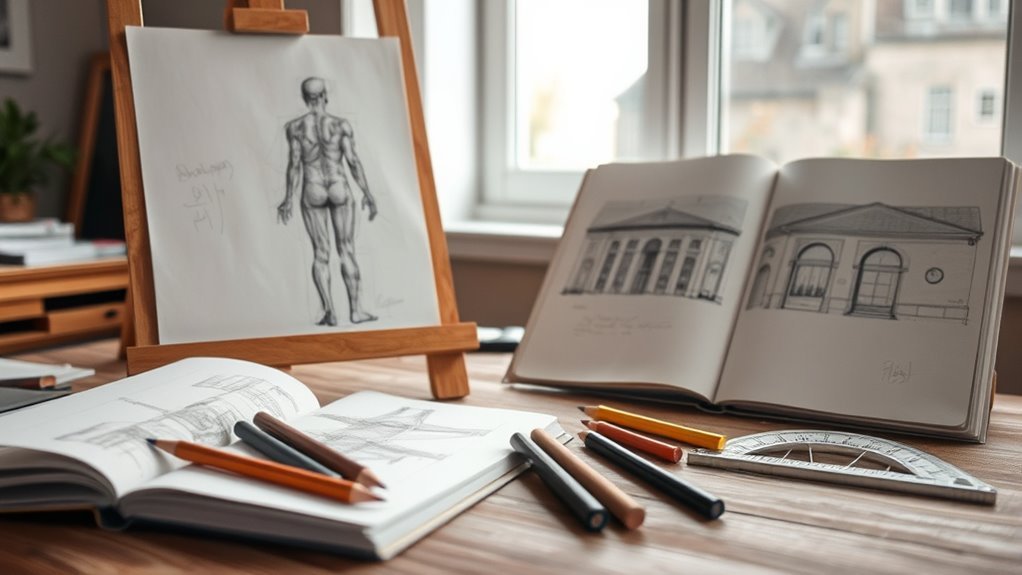
Why do anatomy and perspective matter so much in art? Anatomy gives you a solid understanding of the human body by breaking it down into simplified shapes and studying muscle and bone structure. When you consistently observe and draw from anatomy references, you internalize proportions and movement, which sharpens your figure drawing skills.
Perspective, on the other hand, helps you create depth and spatial relationships in your work. By mastering horizon lines, vanishing points, and different types of perspective—like one-point, two-point, and three-point—you can construct accurate 3D forms.
Combining anatomy with perspective lets you place convincing, proportionate figures into believable environments. Practicing these core fundamentals regularly builds a strong foundation that elevates all your art, making your drawings more dynamic and realistic.
Focus on these essentials, and you’ll see your ability to depict figures and scenes improve dramatically.
Improve Realism Using References and Real-Life Observation
To improve realism in your art, you need to rely on both photo references and real-life observation. These tools help you study accurate anatomy, lighting, and proportions, which are essential for achieving realism.
Don’t just glance at your reference; observe closely and redraw your subject multiple times. Comparing your work side-by-side with the reference really helps boost accuracy.
Focus your study on these key areas:
- Use reference images and live models to understand anatomy and perspective.
- Practice capturing subtle details in light and shadow to enhance depth.
- Observe and replicate textures and surface qualities to add realism.
- Regularly compare your drawings to references to spot and correct errors.
Track Your Art Progress and Learn From Mistakes
Although it can be tempting to focus only on creating new art, tracking your progress is essential for real improvement. Regularly document your artwork by taking photos or saving files. This tracking helps you see how your skills evolve over time.
Don’t shy away from analyzing your mistakes in each piece; identifying recurring issues lets you develop targeted strategies for improvement. Set specific, measurable goals for every study session to keep your progress on track and maintain focus.
Reflection is key—periodically assess your growth and adjust your approach based on what you discover. Keeping a journal or sketchbook to record insights, challenges, and breakthroughs also supports continuous learning.
Focus Deeply on One Subject to Accelerate Learning
Choose one subject, like anatomy or lighting, and immerse yourself in it completely.
You’ll want to consume as much relevant content as possible to build a strong foundation.
This focused approach helps you learn faster and retain more.
Trust me, sticking to one topic at a time makes a big difference!
Targeted Subject Mastery
When you focus deeply on one art subject for at least a month, you accelerate your learning and build a solid foundation. Targeted subject mastery lets you immerse yourself in details that broaden your skills efficiently.
To master your chosen topic, follow these steps:
- Commit to studying one subject, like anatomy or lighting, for a month.
- Explore varied resources—tutorials, books, and references—to enrich your understanding.
- Regularly review and document your progress, highlighting insights and challenges.
- Practice applying theory using real-life or photo references to enhance realism.
Intensive Content Consumption
How can you accelerate your art learning effectively? Start by focusing on one specific subject, like anatomy, lighting, or perspective. Dedicate a whole month to intensive content consumption.
Immerse yourself in various resources—videos, tutorials, books, and reference images—to deepen your understanding. Take detailed notes and analyze what you learn.
Track your progress and key insights for future review. Apply concepts using real-life or photographic references to strengthen your observation and practical skills.
Revisit and refine your knowledge through regular repetition and exercises. This solidifies mastery.
This focused, immersive approach lets you absorb information deeply and accelerates your growth as an artist. It helps you build a strong foundation in one area before moving on.
Learn by Studying and Replicating Artists’ Styles
Although it might feel challenging at first, studying and replicating the works of artists you admire lets you immerse yourself in their techniques and stylistic choices. Start by focusing on one artist’s style to deeply absorb their methods.
Pay close attention to line work, brushwork, shading, and color choices. Use copying as a learning tool—not for commercial use—to understand composition and technique better.
Here’s how you can approach this effectively:
- Choose a piece and analyze its elements, especially line work and shading.
- Redraw or paint over the original to grasp the artist’s method.
- Compare your replication with the original to spot differences.
- Repeat the process with different works by the same artist before moving on.
This practice sharpens your observation skills, helps you internalize diverse styles, and builds a strong foundation for your own creative expression.
Experiment With Media: Watercolor, Digital, and 3D
Exploring different media like watercolor, digital, and 3D opens up new creative possibilities and helps you develop distinct skills unique to each form. Experimenting with these tools lets you uncover unique effects and techniques that can elevate your art.
Watercolor sharpens your control over transparency and blending. Digital art offers quick editing and layering, which is super handy. And 3D modeling builds your grasp of form and spatial relationships.
Trying each medium broadens your skill set and sparks innovation by blending diverse techniques.
| Medium | Key Skill Developed |
|---|---|
| Watercolor | Control over water and pigment |
| Digital | Rapid editing and layering |
| 3D | Understanding form and perspective |
Practice Lighting and Shading to Create Depth and Mood
When you practice lighting and shading, you’ll learn how light shapes objects and sets the mood in your art. Start by shading objects under different light sources to see how light interacts with surfaces and forms.
Use reference photos or 3D models to study how shadows and highlights shift with angles and intensity. Focus on smooth gradients between light and dark to add depth and realism.
Try experimenting with lighting setups like directional, diffused, and ambient light to explore mood variations.
Here’s how to improve your shading skills effectively:
- Observe how light hits objects and creates shadows in real life or references.
- Practice creating smooth transitions between light and shadow to avoid harsh lines.
- Experiment with different light directions to understand mood changes.
- Analyze artworks that use lighting well and try replicating those shading techniques.
Keep practicing these steps consistently, and you’ll deepen your understanding and really boost your art’s emotional impact.
Avoid Burnout: Sustain Your Art Practice Long-Term
How can you keep your art practice alive without feeling overwhelmed or drained? Avoiding burnout means prioritizing consistency over motivation.
Try to establish short, manageable daily or weekly art habits that fit your schedule. Breaking large goals into smaller, achievable tasks helps you maintain steady progress and prevents frustration.
Regular breaks are essential—don’t push through long, exhausting sessions. Balancing effort with rest and leisure keeps your mental and physical well-being in check.
Focus on enjoying the process and learning from mistakes rather than fixating on results. This mindset reduces pressure and keeps your inspiration fresh.
| Strategy | Benefit |
|---|---|
| Short, consistent habits | Builds sustainable momentum |
| Break goals into tasks | Avoids feeling overwhelmed |
| Schedule breaks | Prevents burnout and fatigue |
Frequently Asked Questions
What Is the Best Way to Study Art?
The best way to study art is to focus on specific skills. Break your goals into small, manageable tasks.
Practice regularly, and try to use real-life references whenever you can. It really helps to see things in context.
Also, take some time to analyze works you admire. This gives you insight into different techniques and styles.
Don’t forget to use diverse resources like tutorials and books. They’ll help you build your understanding consistently over time.
What Is the 70/30 Rule in Art?
The 70/30 rule means you spend 70% of your time mastering foundational skills and 30% exploring creativity.
This balance helps you build strong techniques while keeping your art fresh and personal.
It’s all about making sure you get really good at the basics, but also giving yourself enough space to experiment and have fun.
Are ADHD Good at Drawing?
Absolutely, ADHD artists often shine with spontaneous, striking sketches. You’ll find your hyperfocus helps you hone intricate ideas, though distractions might disrupt.
Embrace your unique energy, establish engaging routines, and your drawing skills will definitely grow. Keep at it, and you’ll see amazing progress!
What Are the 10 Principles of Art?
The 10 principles of art are balance, contrast, emphasis, movement, pattern, rhythm, unity, variety, scale, and proportion. You use these to organize elements and create harmony, interest, and effective visual compositions in your artwork.
These principles help guide how you put your art together. They make sure everything feels just right and keeps people looking at your work. It’s like having a recipe for making your art look its best.
Conclusion
By setting manageable goals and embracing steady routines, you’ll gently nurture your artistic growth without feeling overwhelmed. Remember, mastering fundamentals and experimenting with different media isn’t just about skill—it’s about discovering your unique voice.
Tracking progress and learning from slip-ups keeps you on a meaningful path. With patience and self-kindness, you’ll avoid creative fatigue and turn your practice into a lasting journey of joyful exploration and expression.
Keep painting your story. Studying art effectively means balancing discipline with creativity. When you stay consistent and open to new techniques, your skills naturally improve. So, keep exploring, stay curious, and most importantly, enjoy every step of your artistic journey. This way, your study of art becomes a fulfilling, ongoing adventure that helps you grow not just as an artist, but as a creative individual.