What Are Values in Art and How Can Beginners Use Them?
Values in art are the lightness or darkness of colors that help you create depth, form, and contrast. These values are super important because they make your artwork look three-dimensional and more realistic. They also guide the viewer’s eye to important areas, helping tell your story or highlight key parts of your piece.
As a beginner, a great trick is to squint your eyes to simplify shapes and focus on the values rather than details. Using a value scale can help you match tones more accurately, which makes a big difference in your work.
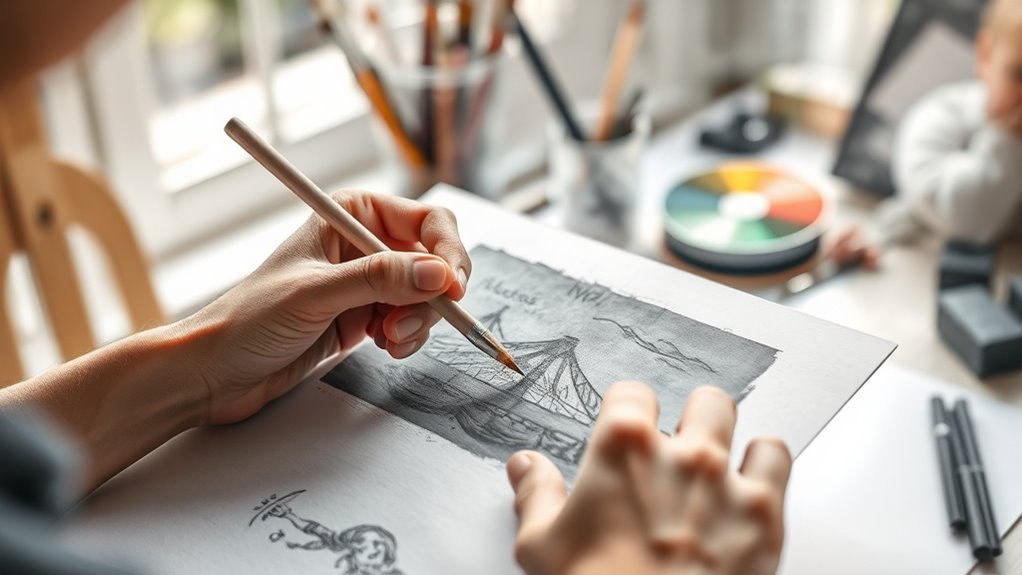
Try practicing with everyday objects and making monochrome sketches. This will really improve your sense of light and shadow. Keep exploring these techniques, and you’ll find more powerful ways to shape mood and space in your art.
It’s all about seeing and using values to bring your pieces to life!
Key Takeaways
- Values are the lightness or darkness of colors that create contrast and define depth in artwork.
- Beginners can use squinting to simplify shapes and better perceive light and dark relationships.
- Using a value scale helps compare and match tones for accurate shading and contrast.
- Practicing with household objects trains observation of real-world value variations.
- Creating monochrome underpaintings allows focus on establishing strong light and shadow foundations.
What Are Values in Art and Why Do They Matter?
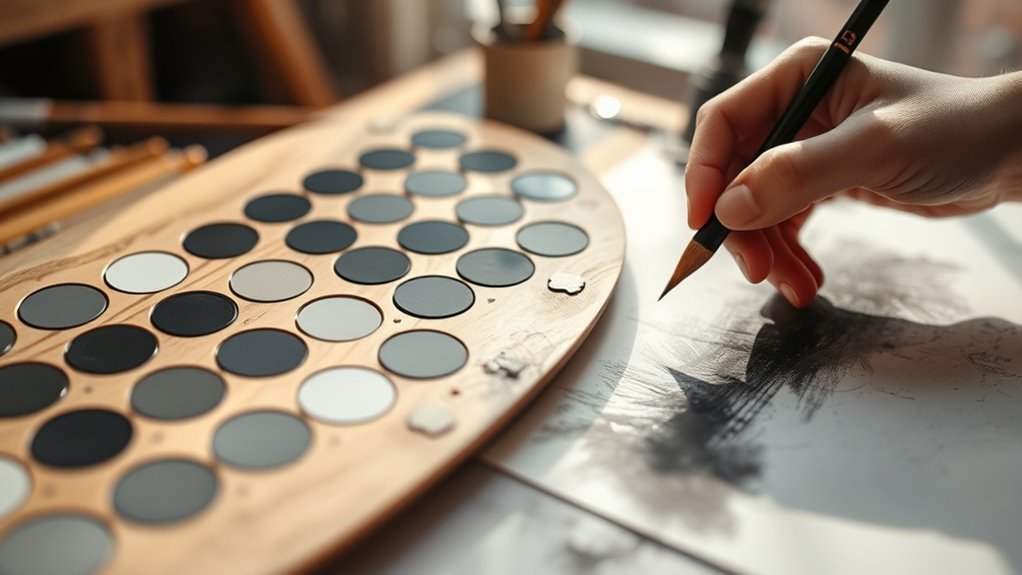
Although you might focus on colors when creating art, understanding values—the lightness or darkness of a color—is essential for making your work look realistic and dynamic. Values define the contrast between lightness and darkness in your piece, helping you establish depth and form.
When you use a value scale effectively, you create convincing light and shadow that give objects a three-dimensional appearance. This contrast guides the viewer’s eye and enhances your composition by emphasizing important areas and creating mood.
Even without color, accurate value relationships can depict space and volume clearly. Mastering values lets you build a strong foundation in your art, allowing you to manipulate light and shadow purposefully.
How Beginners Can Identify and Use Values to Improve Their Art

Understanding values sets the stage for improving your art, but learning how to identify and apply them takes practice. To see the value range clearly, squint at your subject to simplify shapes and notice the contrast between lightness and darkness.
Use a value scale—whether 3 or 9 steps—to compare and match tones. This will help you enhance your perception of value differences.
Practicing with household objects and creating monochrome underpaintings will help you establish solid foundations before adding color. It’s a great way to focus on values without getting distracted by hues.
| Technique | Purpose | Benefit |
|---|---|---|
| Squinting | Simplify shapes | See light/dark relationships |
| Value scale (3 or 9 steps) | Compare lightness and darkness | Improve tonal matching |
| Household object study | Observe real values | Train perception |
| Monochrome underpainting | Establish base values | Focus on light and darkness |
| Using grey card | Reference for true value | Accurate value replication |
Frequently Asked Questions
What Is an Example of Value in Art for Beginners?
An example of value for you is shading a simple sphere, focusing on light, midtones, and shadows. This helps you see how light affects form, making your drawings more realistic and giving depth without relying on color.
It’s like learning to see the world in shades, not just colors. Once you get the hang of this, your art will start to pop with more life and dimension.
How to Use Values in Art?
You use values by squinting to see light and dark areas, matching them to a value scale. Start by blocking in large shapes first, then gradually add darker tones.
This way, you build depth and structure in your artwork effectively. It really helps bring your piece to life!
What Is Value in Art in Simple Terms?
Ever wonder how artists make things look real? Value in art is simply how light or dark something appears.
You’ll use it to show shadows, highlights, and depth, making your work pop and feel alive. It’s a cool trick that helps pictures look more interesting and realistic.
What Are the 7 Values of Art?
The 7 values of art are pure white, light tints, mid-tones, darker shades, deep shadows, and pure black. You’ll use these to create contrast, depth, and focus.
This makes your artwork more dynamic and realistic. It’s all about playing with light and dark to bring your pieces to life.
Conclusion
Remember, a picture is worth a thousand words, and mastering values lets you speak volumes without saying a thing. By understanding light and shadow, you bring depth and emotion to your art, making it feel alive.
As a beginner, don’t rush—practice seeing values everywhere. Soon, your work will shine with realism and mood.
Embrace values, and watch your creativity transform simple shapes into compelling stories. Keep experimenting, and you’ll grow every day! Using values effectively helps you create contrast, depth, and atmosphere, which are essential for powerful artwork. So, focus on learning values in art to elevate your skills and bring your ideas to life with emotion and realism. Keep practicing, and your art will improve steadily!