What Is One Point Perspective in Art?
One point perspective in art helps you create realistic depth by using a single vanishing point on the horizon line. You’ll see parallel lines converge toward that point, making flat images look three-dimensional.
This technique is great for front-on views, like roads or rooms, where receding lines give a true sense of distance and scale.
By mastering the horizon line, vanishing point, and guiding lines, you can make your artwork feel immersive and spatially accurate. It’s a simple yet powerful way to add realism to your drawings.
There’s more to uncover about how these elements work together. Once you get the hang of one point perspective, it opens up new possibilities for creating depth in your art.
Key Takeaways
- One point perspective uses a single vanishing point on the horizon line to create depth in art. Parallel lines recede and converge at the vanishing point, enhancing spatial realism.
- It works best for front-on views of objects and scenes. The horizon line represents the viewer’s eye level and anchors the composition.
- This technique transforms flat images into three-dimensional, immersive scenes. It really helps bring drawings to life!
What Is One Point Perspective?
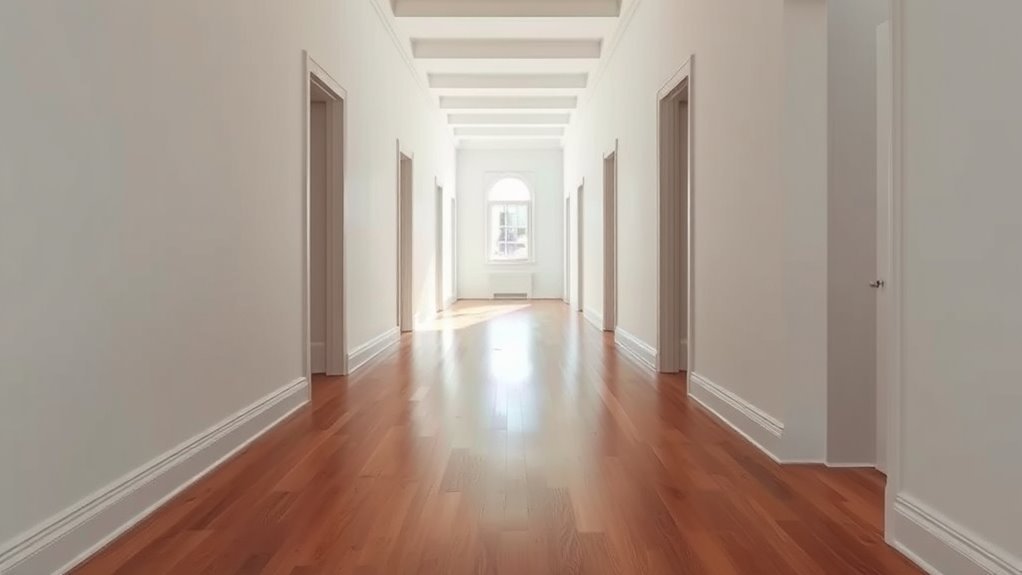
What makes one point perspective so effective? It’s the way this drawing method uses a single vanishing point on the horizon line to guide perspective lines. When you draw receding lines that converge at this vanishing point, you create a powerful illusion of depth on a flat surface.
This linear perspective technique works best with a front-on view, where objects face you directly. By applying one point perspective, you can accurately depict how parallel lines seem to shrink and come together as they move away from you.
One point perspective excels with front-facing views, showing parallel lines shrinking and converging realistically in depth.
This convergence tricks your eyes into seeing three-dimensional space, making scenes like roads, buildings, or interiors look realistic. When you use this method, you control how depth appears, giving your artwork a sense of distance and scale.
In short, one point perspective helps you transform flat images into believable, spatially accurate compositions.
Key Elements of One Point Perspective: Horizon Line, Vanishing Point, and Orthogonals

How do artists create the convincing illusion of depth in one point perspective? They rely on three key elements: the horizon line, the vanishing point, and orthogonals.
The horizon line represents the viewer’s eye level and divides the scene into sky and ground, anchoring the perspective. The vanishing point sits on this horizon line and is where all receding lines, called orthogonals, converge.
These orthogonals are diagonal lines that guide your eye toward the vanishing point, creating the illusion of objects receding into space. Lines parallel to the front-facing surfaces stay horizontal or vertical, maintaining the flat surface’s structure.
By carefully placing the vanishing point and drawing orthogonals, artists depict three-dimensional depth on a flat surface. This technique tricks your eye into seeing realistic depth and distance, making the artwork feel immersive and spatially accurate.
Understanding these elements helps you grasp how perspective transforms a flat image into a believable, three-dimensional scene.
Frequently Asked Questions
What Are the Three Rules for One-Point Perspective?
You follow three rules for one-point perspective: all receding lines must converge at a single vanishing point. Horizontal and vertical lines stay true and parallel.
And the vanishing point sits precisely on the horizon line at your eye level. It’s pretty straightforward once you get the hang of it!
What Is One Point and Two-Point Perspective Drawing?
You don’t need a telescope to see one-point perspective—it’s just lines all converging to one dot.
Two-point perspective? It’s like giving your drawing a corner seat.
It shows two sides with two vanishing points.
What Famous Artwork Has One-Point Perspective?
You’ll find one-point perspective in Leonardo da Vinci’s *The Last Supper*, Raphael’s *School of Athens*, Van Gogh’s *Bedroom in Arles*, and Canaletto’s cityscapes.
They all guide your eye toward a central vanishing point. It’s like the artists are leading you right into the heart of the scene.
What Is the 1 Point Perspective?
One-point perspective is like a road stretching straight ahead, guiding your eyes to a single vanishing point.
You use it to make flat drawings look deep and realistic by converging lines toward that point on the horizon.
Conclusion
Now that you understand one point perspective, you can create artwork that feels as real as looking down a long, straight road. By using the horizon line, vanishing point, and orthogonals, you’ll guide viewers’ eyes right where you want them.
It’s like giving your drawings a secret map, making flat images pop with depth and life. So, don’t hesitate—start experimenting, and watch your art come alive before your eyes!
One point perspective is a powerful tool in art to create a sense of depth and realism. By mastering it, you can transform simple sketches into dynamic scenes that draw people in. Keep practicing with the horizon line, vanishing point, and orthogonals to make your artwork truly stand out.